

A Cryptographic Protocol for Verifiable Execution History
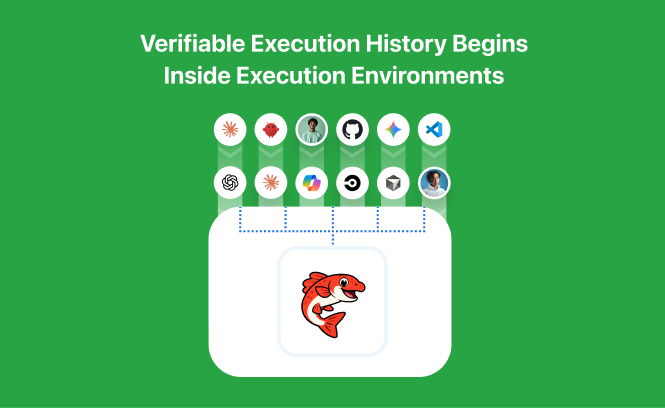
Consequential execution happens at machine speed. Events observed afterwards support multiple plausible histories. Salmon establishes Verifiable Execution History across humans, agents, and automation, recorded as execution occurs, so downstream systems reason from the record.
Autonomous Execution Requires a Verifiable Execution Record
As execution becomes autonomous and multi-actor, consequential state changes become increasingly difficult to attribute, reconstruct, and verify from fragmented records alone. Salmon establishes a Verifiable Execution Record across supported human, agent, and automated execution that downstream systems can consume for attribution, reconstruction, and verification.
Humans
Who acted. What changed.
Copilots
What was suggested. What was accepted.
AI Agents
What executed. What produced the outcome.
Multi-Agent Systems
How execution propagated. Which actors participated.
Every Recorded Transition Is Signed, Fingerprinted, and Linked
Verifiable Execution History is constructed from signed execution events. Recorded execution becomes a sequence of events, each signed at the moment it happens rather than attached afterwards.
An event holds fingerprints of the recorded state on both sides of the transition, providing cryptographic evidence that the recorded state differs rather than relying on a textual description of the change. Events link to the one before, which is what makes the record a chain rather than a list.
A state the recorded chain cannot account for is itself a finding.
Execution Verification Becomes Foundational Infrastructure
As autonomous AI agents drive multi-actor execution in production at scale, downstream systems increasingly require machine-consumable evidence of what occurred, to strengthen detection, investigation, attribution, reconstruction, and response.
 Execution Verification Infrastructure
A cross-runtime execution-verification layer, not a point feature inside any single application, agent framework, security product, or cloud.
Why Execution History Became a Systems Problem
Previous generations of infrastructure established important primitives for communication, identity and trust, software history, and provenance. These systems were designed around different properties and do not necessarily establish a verifiable execution history linking supported execution to recorded state transitions.
Execution History for Multi-Actor Software Systems
Execution now comes from AI agents, humans, and automation. Salmon establishes a verifiable execution record for supported execution, captured as it occurs rather than reconstructed solely afterwards.